Effective leadership communication is how exec teams create shared understanding around direction, priorities, and decisions. It’s the difference between an organization that knows what’s happening and one that knows what actually matters.
This is where leadership communication diverges from everyday communication. It isn’t just about conveying information or running meetings efficiently. It’s about helping people understand why decisions are being made, how their work connects to the bigger picture, and what’s expected of them next.
Good leadership communication does three things consistently. It articulates vision so people know where you’re headed. It creates two-way dialogue so information flows up as well as down. And it aligns words with actions, because people pay far more attention to what you do than what you say. When those elements are missing, communication turns into noise. Noise erodes trust fast.
Explain why communication skills matter for leaders
Every leadership problem eventually shows up as a communication problem.
Teams drift when priorities aren’t clear. Projects stall when expectations are implied instead of stated. Conflict escalates when feedback is delayed or softened beyond recognition. In remote or fast-growing organizations, small communication gaps don’t stay small. They compound.
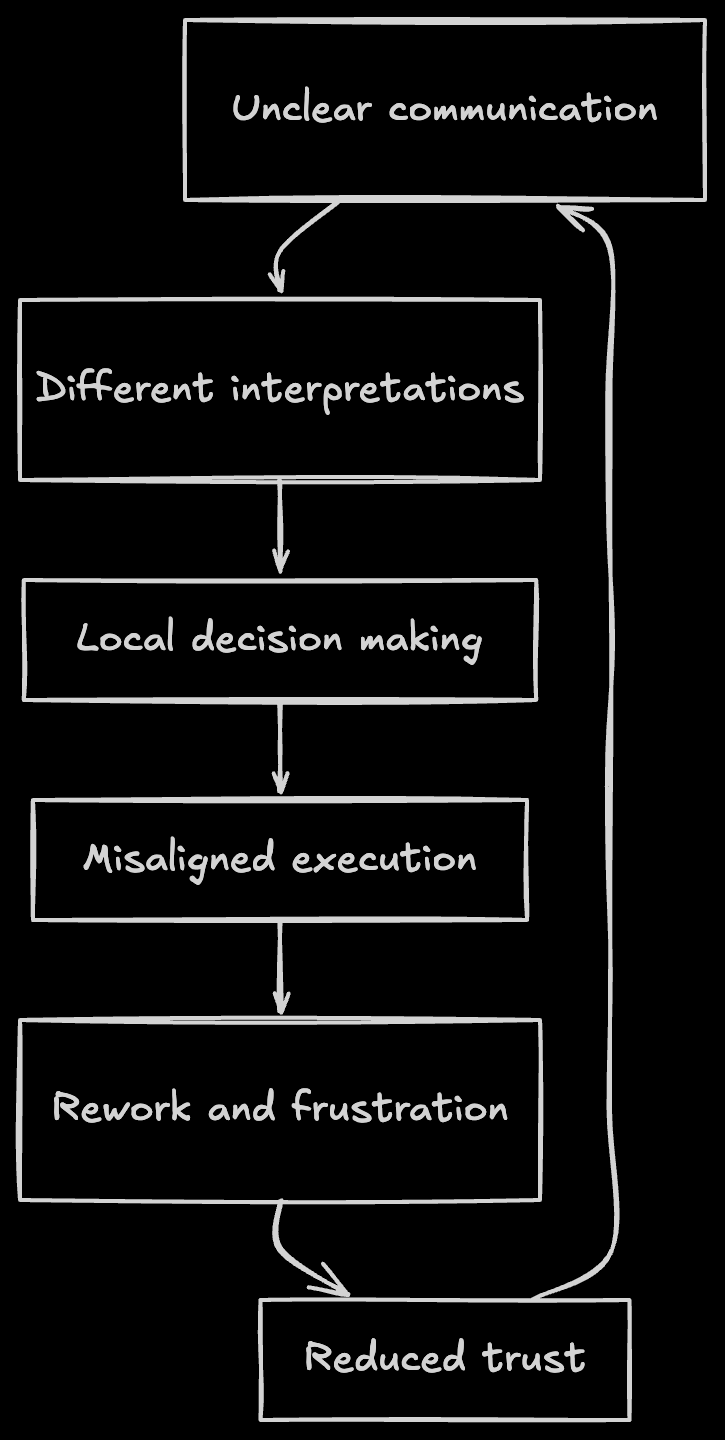
This is especially true when leaders are communicating upward as well as downward. Managing stakeholders, executives, or cross-functional partners requires the same clarity and intent as leading a team. If that’s a skill you’re actively developing, I’ve written separately about what it really means to manage up effectively and why it’s inseparable from strong leadership communication.
When leadership communication works, teams move with less friction. People make better decisions without waiting for approval. Problems surface earlier, when they’re still solvable. Trust builds because people understand not just what is happening, but why.
When communication breaks down, leaders often respond by communicating more. Longer messages, more meetings, more Slack posts. That usually makes things worse. Clarity doesn’t come from volume. It comes from intention, structure, and follow-through.
Core leadership communication skills
These skills show up across roles, industries, and company sizes. Most leaders are decent at one or two and unconsciously avoid the rest. That avoidance is usually where things break down.
Clarity and directness
Clarity means saying what you mean without hedging, jargon, or relying on shared context that doesn’t actually exist. Directness means not making people guess whether something is a suggestion, a preference, or a requirement.
Consider the difference between “Let’s try to move faster on this” and “I need a draft by Thursday so we can review it on Friday.” One sounds collaborative. The other is actually useful.
Clarity isn’t about being harsh or abrupt. It’s about respecting people’s time and cognitive load. If your team regularly leaves meetings with different interpretations of what was decided, that’s not a listening problem. It’s a clarity problem.
Active listening
Active listening is one of those skills everyone claims to have and very few people practice consistently.
It means paying full attention, asking clarifying questions, and reflecting back what you heard before jumping to solutions. It also means resisting the urge to prepare your response while someone else is still talking.
When leaders don’t listen, they solve the wrong problems confidently. When they do listen, people feel heard. People who feel heard contribute more, flag issues earlier, and take more ownership. Listening isn’t passive. It’s how you get access to information you can’t see from the top.
Storytelling and narrative
Storytelling is how leaders make change understandable.
Data explains what’s happening. Narrative explains why it matters and how the present connects to the future. Without that context, even well-reasoned decisions can feel arbitrary or threatening.
For example, “We’re reorganizing the team” lands very differently than “We’ve outgrown our current structure, and decisions are slowing down. This change is about clarifying ownership so work doesn’t get stuck.” The facts might be the same. The impact isn’t.
Narrative doesn’t mean embellishment. It means framing reality in a way people can process, remember, and act on.
On mixed teams, narrative becomes less about inspiration and more about alignment. Technical roles often hear change in terms of risk and scope. Creative and DevRel roles hear it in terms of audience impact and autonomy. A clear narrative creates shared ground. It explains not only what is changing, but what is staying the same, and why the tradeoff makes sense across disciplines.
Adaptability across audiences
Strong leaders adjust how they communicate without changing the substance of their message.
Executives want tradeoffs and outcomes. Technical teams want constraints and rationale. Cross-functional partners want impact and dependencies. Saying the same thing to everyone, in the same way, isn’t consistency. It’s laziness.
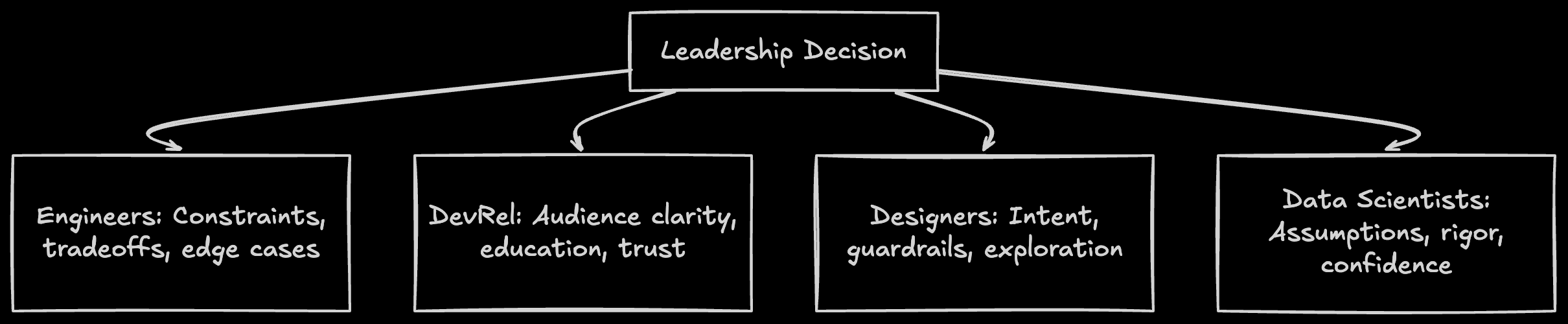
I’ve led mixed teams of engineers, DevRel practitioners, designers, content creators, and data scientists at companies like Okta and Split. The hardest part was never aligning people on goals. It was aligning them on language.
Engineers wanted constraints, edge cases, and tradeoffs. DevRel teams optimized for clarity, education, and audience trust. Designers needed intent and guardrails without over-specification. Data scientists wanted rigor, assumptions, and confidence in the inputs. Saying the same thing to all of them guaranteed confusion. Effective leadership communication meant translating the same decision into different frames, without diluting the core message.
Transparency and honesty
Transparency means sharing context, explaining decisions, and admitting uncertainty when it exists. It also means closing loops, especially when plans change.
People are generally fine with not having all the answers. What they struggle with is feeling managed through spin or selective disclosure. Once people sense that information is being withheld or massaged, trust erodes quickly.
Honesty isn’t about oversharing. It’s about being real enough that people don’t have to guess what’s actually going on.
Empathy and emotional awareness
Empathy in leadership communication is about recognizing that work happens in a human context. Pressure, frustration, uncertainty, and fatigue all affect how messages land.
Acknowledging those realities doesn’t weaken authority. It strengthens credibility. Leaders who ignore emotional signals don’t eliminate them. They push them underground, where they show up later as disengagement or resistance.
Empathy doesn’t mean agreement. It means understanding the perspective you’re leading through.
Asking questions that open dialogue
The quality of a leader’s questions often matters more than the quality of their answers.
Closed questions shut conversations down. Open ones invite thinking, surface risks, and uncover assumptions. Asking “Does anyone disagree?” rarely yields insight. Asking “What concerns would you raise if this fails?” usually does.
Good questions signal curiosity and respect. They also reduce blind spots, especially the ones leaders don’t know they have.
Giving and receiving feedback
Feedback is one of the most avoided and most necessary forms of leadership communication.
Effective feedback is timely, specific, and focused on behavior rather than intent. It’s delivered in small doses, not saved up for formal reviews. It also includes follow-up, not just delivery.
Receiving feedback matters just as much. Leaders who get defensive teach their teams to stay quiet. Leaders who listen and adjust make feedback safer over time.
Apply leadership communication in practice
Skills only matter if they show up consistently in behavior.
1. Communicate with consistent frequency
Silence creates anxiety. In the absence of information, people fill the gaps themselves, and they’re rarely optimistic about it.
Establish predictable rhythms so people know when they’ll hear from you. Consistency builds stability, even when the message isn’t great.
2. Set expectations before problems arise
Most communication breakdowns start at the beginning. Clarify ownership, scope, and success criteria upfront. Retroactive alignment is always harder.
3. Match the medium to the message
Sensitive topics deserve real-time conversation. Complex decisions benefit from written context people can revisit. Quick updates belong in async channels. The medium shapes the message more than leaders often realize.
4. Read the room and adjust
If people stop asking questions, that’s not alignment. It’s disengagement. Pause, check understanding, and adjust instead of plowing ahead.
5. Follow through on what you say
Credibility is built when words and actions match. If priorities change, say so. If you commit to something, close the loop. Inconsistency is noticed immediately.
6. Initiate difficult conversations early
Avoiding hard conversations doesn’t make them easier. It makes them heavier. Address issues directly, early, and with empathy.
Avoid common leadership communication mistakes
- Assuming your message landed because you said it
- Withholding feedback until it turns into a crisis
- Overloading people with information instead of prioritizing
- Saying one thing and doing another
- Rushing communication and creating confusion that takes longer to fix
Most of these aren’t skill gaps. They’re avoidance patterns.
Improve your leadership communication skills
Improvement starts with awareness, not reinvention.
Ask for specific feedback about what’s unclear. Record yourself in meetings to notice habits you miss in real time. Practice listening without interrupting. Study communicators you admire and identify what they do, not just that they’re effective. Focus on one skill at a time. Progress compounds.
Evaluate your communication as a leader
You’ll know your communication is working when people can repeat priorities accurately, problems surface early, and misalignment surprises you less often.
If people stop asking questions altogether, that’s a signal, not a success.
Recognize how communication shapes your leadership
Leadership communication isn’t a soft skill. It’s the infrastructure everything else runs on.
Clarity, trust, and alignment don’t come from talking more. They come from communicating with intention, consistency, and self-awareness. Especially in complex, technical, or fast-changing environments, communication isn’t optional. It’s leverage.
FAQs about leadership communication
How do you communicate as a leader when you don’t have all the answers?
Be clear about what you know, what you don’t, and what happens next. Honesty builds more trust than pretending certainty.
What’s the difference between leadership communication and management communication?
Leadership communication focuses on vision and meaning. Management communication focuses on execution and process. Most leaders need both.
How do you measure whether your leadership communication is working?
Look at alignment, timing of feedback, how accurately messages are repeated, and direct input from your team.
How should leaders communicate in remote or async environments?
Over-communicate context in writing, use video for sensitive topics, and establish clear norms for channels and response times.
How do you develop your own communication style as a leader?
Pay attention to what feels natural, get feedback on when you’re most effective, and refine over time. Authenticity comes from awareness, not imitation.