There’s a specific piece of understanding that is missing when teams are scaling content, and it’s dead-obvious on the surface, but often not clear when you dig in: A content system is not the same as your CMS. In reality, a content system is the architecture and process built on top of your CMS. It’s the the invisible rails that make content production repeatable, sustainable, and actually useful.
This distinction between tools and systems is subtle in conversation but catastrophic in practice. A content management system is not a content system. The former is software; the latter is an operating model. And confusing the two is why so many teams end up with publishing chaos, fragmented processes, and content that gets neither engagement nor clarity.
If you’ve ever watched a team sprint for months on content only to find that nothing improves — not velocity, not quality, not reuse — it’s because they optimized the surface (tools) and ignored the substrate (systems).
When Software Isn’t the System
Let’s be honest: buying a new CMS feels like doing something. You’ve chosen a vendor, signed a contract, onboarded users, and maybe even migrated content. People can create pages. That feels like progress. But if the rest of your company still asks, “Who owns this draft? Where does this go next? Who approves it? What problem is it supposed to solve?” then you haven’t built a system — you’ve bought a new spreadsheet.
A content system isn’t just a repository or an editor. It’s the set of decisions, constraints, and flows that determine how content gets made, by whom, and why. It connects a why and a how to an outcome that matters. A CMS alone doesn’t do that. It simply enables one slice of your workflow.
That’s why teams with robust content systems can thrive even with basic tooling, and teams with expensive CMSs languish. Systems endure. Tools don’t.
What We’re Really Talking About
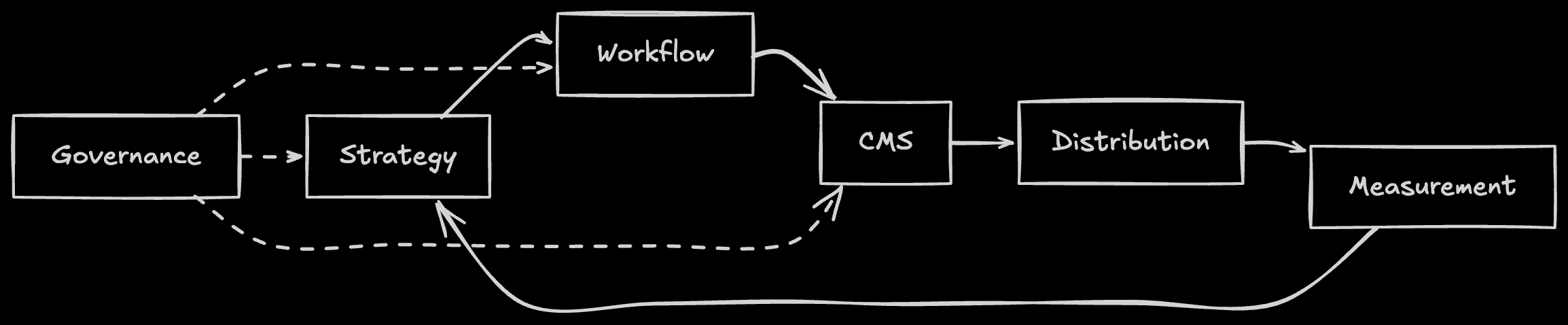
When we talk about a content system, we mean something far broader than a collection of content types or a taxonomy in a CMS. We mean a framework that connects strategy, workflow, governance, tools, and measurement into a single operating model.
A content system answers the fundamental questions teams silently fight about. Why are we creating this piece instead of something else? Who owns each step of the process? How do we reuse content instead of rewriting it? When is something “done”? What happens to content that’s old, irrelevant, or incorrect?
If you can’t answer those questions beyond “ask so-and-so,” you don’t have a system. You have an informal ritual.
The Real Difference Between a CMS and a Content System
You’re reading blog posts about headless CMS platforms, API-first content delivery, and multichannel publishing, and that’s all fine, those are tools, and they matter. But they aren’t the system itself, any more than a paintbrush is the Sistine Chapel. They shape what’s possible, not what is.
A content management system exists to make content available. Whether it renders HTML pages, serves structured data to a frontend, or exposes assets to multiple channels, its job is to store and deliver content reliably. That’s a critical capability. But if you stop there, you’ve optimized for storage, not impact.
A content system, by contrast, ensures that every piece of content has a reason to exist, a clear lineage from idea to publication, and a path for continuous refinement. It’s about accountability and coherence, not just availability — and it’s the difference between having a CMS and being able to scale content as a strategic asset.
Why This Matters (Especially Now)
In the early days of the internet, publishing itself was the bottleneck. Today, especially with AI now in the mix, publishing is trivial. What’s hard is coordination, consistency, and leverage. I’ve written about responsible AI content creation for teams navigating that shift.
Teams can publish dozens or even hundreds of pieces, yet still feel like they’re drowning in half-finished drafts, conflicting priorities, and no way to measure what’s actually working. The reason isn’t that content is inherently harder. It’s that content problems are systems problems. They span roles, teams, and incentives — and without a system, they collapse into ad hoc work.

I saw this most clearly working on content at companies like Okta, where content isn’t just marketing collateral, it’s part of how trust is established and maintained. Documentation, guides, and product explanations all have real consequences when they’re outdated or wrong. At that scale, content systems stop being about efficiency and start being about risk containment. Without a system, inconsistency isn’t just messy, it’s dangerous.
How Content Systems Actually Work in Practice
I’ve watched teams spend months building content “playbooks” that sit untouched in a shared drive. I’ve also seen teams with no formal documentation at all produce cleaner, faster, more effective content because their systems were embedded in how decisions were made and work moved forward.
A content system isn’t defined by how well it’s documented. It’s defined by behavior — the defaults people fall into when no one is watching. This is the same philosophy I explored in “Good Developer Content Is a Conversation, Not a Broadcast”, where effective content isn’t something you simply ship — it’s something that responds to real questions, real friction, and real feedback.
In practice, effective content systems behave less like pipelines and more like feedback loops.
The Tools Are Necessary, Not Sufficient
We do need CMS platforms. We need content APIs, asset storage, versioning, localization support — all the machinery that modern content demands. But tools are like engines in a car. Without a roadmap and rules of the road, an engine doesn’t get you anywhere useful.
That distinction became especially clear working with developer-first teams at companies like Split. These teams often had sophisticated tooling and modern infrastructure, yet still struggled to scale content effectively. The limiting factor wasn’t the CMS or delivery mechanism. It was unclear ownership, inconsistent audience definitions, and workflows that existed only in people’s heads. The tools were capable; the system wasn’t.
A CMS becomes meaningful only when it serves a process people trust. When the system around it is well understood, the CMS fades into the background. It stops being the thing teams argue about and starts being the thing that quietly enables good work.
What Happens Without a System
Without a content system, teams tend to fall into one of two modes. Either content becomes chaotic — scattered across tools, duplicated endlessly, and inconsistent in tone and structure — or teams swing in the opposite direction and let their tools dictate the process, mistaking rigidity for control.
Both outcomes feel familiar to anyone who’s lived through CMS migrations, editorial fire drills, or documentation sprawl. That’s not growth. That’s entropy.
Building a Content System That Works
Building a content system doesn’t start with software. It starts with questions about outcomes, audiences, and usefulness. What decisions are you trying to support? Who is this content actually for? How will you know if it’s working?
Answering those questions forces you to define principles that guide creation and governance. Only then do tools enter the picture, selected to support those principles rather than define them. This mirrors what I’ve written about in “What Is Developer Marketing? A Guide from the Trenches”, where content succeeds not because it exists, but because it’s connected to adoption, trust, and meaningful signals.
A strong content system assumes change. It’s designed to evolve as products, teams, and audiences change.
A Content System Is Less About Perfection, More About Usefulness
Perfect systems don’t exist. Useful ones do.
At companies like ngrok, content isn’t something users encounter after the product, it is part of the product. Documentation, examples, and explanations shape how quickly users succeed and how much they trust what they’re building. In environments like that, weak content systems surface immediately, because friction in content becomes friction in adoption.
This is also where clarity and framing matter. The gap between raw technical accuracy and real understanding is something I explore more deeply in “Technical Storytelling: Bridging Engineering and Narrative”. A strong content system makes that translation repeatable, not accidental.
A good content system doesn’t prevent mistakes. It makes them visible early and recoverable. It doesn’t eliminate complexity — it helps people navigate it. Most importantly, it treats content as a strategic capability, not a checklist of posts to ship.
Why You Should Care
Content is how teams learn, how customers understand products, and how trust is built over time. When content is systematic, it becomes infrastructure. When it isn’t, it becomes noise.
A content system gives you leverage. It makes quality repeatable without requiring heroics. And in a world where attention is scarce and expectations are high, that leverage is a competitive edge.