Over the last two years, AI has quietly integrated itself into all of our content workflows. We use it to sketch outlines, smooth paragraphs, and quickly summarize concepts.
And now it feels like AI is everywhere — shaping language, structure, and tone — while the systems around it have remained vague. Everyone has opinions on where it’s appropriate and how much review it needs. These opinions rarely agree, and no one is consistently holding the reins.
So let’s talk about it. And let’s talk from inside an AI-assisted writing system, one where AI is present, useful, and constrained by design. What follows isn’t a manifesto or a checklist. It’s an attempt to make visible the human decisions that actually make AI use responsible, especially in content that people rely on to be accurate, clear, and trustworthy.
What Responsible AI Content Creation Means in Practice
Responsible AI content creation is often described in abstract terms, but in practice it comes down to a small set of concrete decisions. It means using artificial intelligence tools intentionally, with clear oversight and explicit ownership of the final result.
AI doesn’t understand truth, audience, or consequence. It predicts language based on patterns. Everything that gives content meaning (accuracy, relevance, usefulness, credibility) still comes from human judgment layered on top. When that judgment is missing or unclear, AI doesn’t fail loudly. It fails by quietly producing content that sounds plausible until someone tries to use it.
Responsible use begins with acknowledging this limitation and designing workflows that compensate for it rather than pretending fluency is the same thing as understanding.
Why Responsible AI Standards Matter for Content Teams
Without standards, AI creates a convincing illusion of progress. Content ships faster. Output increases. Documentation expands. And yet quality often degrades in ways that are subtle enough to escape notice until they accumulate.
This becomes especially visible with technical and developer audiences, the place where I live. Our readers are quick to detect inaccuracies, generic explanations, or instructions that collapse under real-world use. Once trust is lost here, it’s difficult to regain.
This kind of drift isn’t unique to AI. It’s what happens any time content production outpaces the systems meant to support it. I’ve written before about how technical storytelling breaks down when narrative replaces understanding rather than reinforcing it.
Clear standards remove ambiguity. They don’t slow teams down. They make it possible to move quickly without renegotiating responsibility every time AI is involved.
Who Is Accountable for AI-Generated Content
One of the clearest warning signs of irresponsible AI use is the phrase “the AI wrote it.” That’s not an explanation. It’s an abdication.
Accountability for AI-generated content must be human, and it must be assigned before anything is published. Otherwise, responsibility evaporates the moment something goes wrong.
Leadership owns the system. Executives decide whether AI is used at all, what kinds of content it’s appropriate for, and how much risk the organization is willing to tolerate. They also decide whether teams are given enough time and support to review AI output properly. Pushing for speed without guardrails is still a decision — just an unacknowledged one.
Content creators and editors own execution. Writers are responsible for how AI is used: the prompts, the framing, and the judgment applied to its output. Editors are responsible for what ultimately goes live. AI doesn’t lower editorial standards. It raises them, because fluency is no longer a reliable proxy for correctness.
Tool providers matter, but they do not assume responsibility for your content. If you publish it, you own it.
Ethical Principles That Actually Hold Under Pressure
Ethics in artificial intelligence content creation is often discussed as a set of ideals. In practice, responsibility collapses into a few principles that show up again and again.
Accuracy comes first. AI can generate confident, articulate prose that is simply wrong. Every factual claim, statistic, and technical explanation must be verified against reliable sources before publication. This is non-negotiable for technical and developer-focused content, where errors waste time and damage trust.
Bias is less visible but just as real. AI reflects the data it was trained on, which means it can reinforce assumptions, omit perspectives, or frame issues in subtly distorted ways. Responsible teams build review habits that actively look for these patterns instead of assuming neutrality.
Authenticity keeps AI-assisted content from feeling hollow. Content can be technically correct and still fail if it isn’t grounded in real expertise and intent. Human oversight isn’t just about catching errors; it’s about ensuring the work is actually useful.
Privacy rounds out the ethical foundation. Feeding proprietary, customer, or confidential information into AI tools without understanding where that data goes isn’t a tooling mistake. It’s a trust violation.
Transparency and Disclosure Without the Performance
Disclosure is often framed as a binary question: did you say you used AI or not? That framing misses the point.
The more useful question is whether AI use materially changes how an audience should interpret the content. If it does, transparency matters. If it doesn’t, disclosure can add noise without value.
For technical and developer content, expectations are high by default. Readers assume accuracy and authorship. If AI plays a meaningful role in shaping that content, disclosure isn’t about optics — it’s about maintaining an honest relationship with the audience.
What doesn’t work is hiding AI use out of fear, or disclosing it in ways that feel performative. Responsible transparency is contextual, not absolutist.
Governance: Where Responsibility Becomes a System
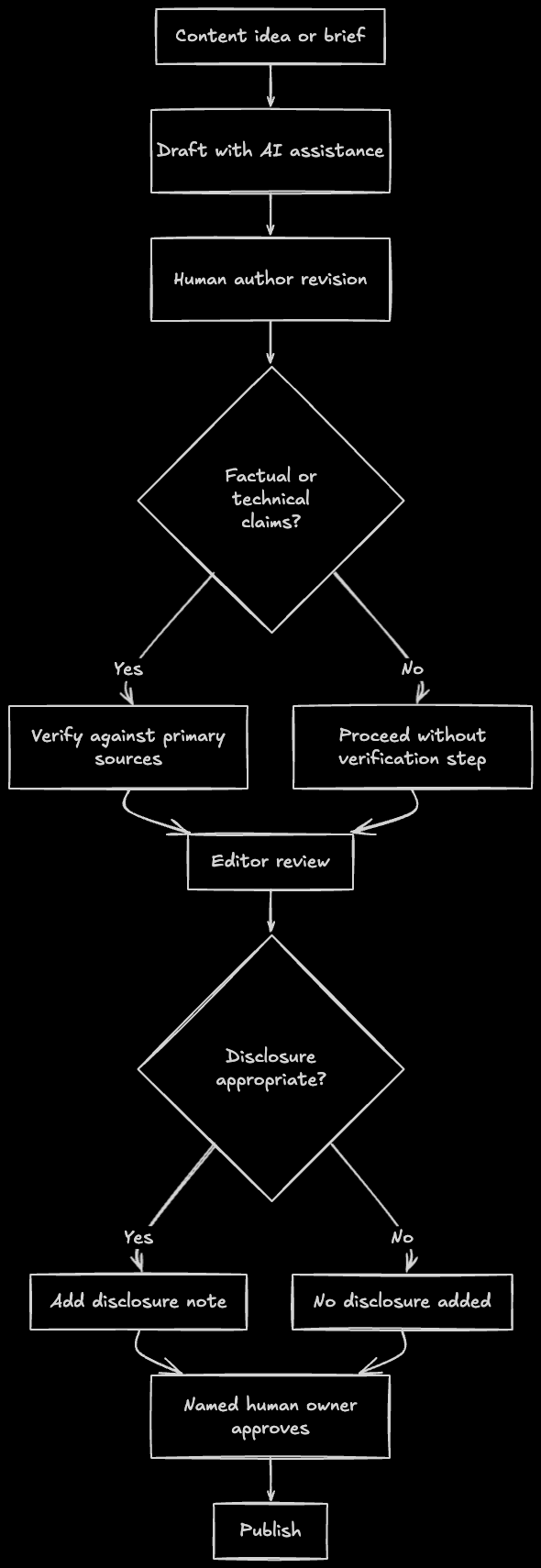
Governance matters because responsibility evaporates under deadline pressure unless it’s structurally enforced.
Written policies define where AI can and can’t be used, what level of review is required, how disclosure decisions are made, and how edge cases are escalated. Writing this down isn’t bureaucratic overhead. It’s how teams surface disagreements early, when they’re still cheap to resolve.
Workflows matter because responsibility has a tendency to evaporate under deadline pressure unless it’s structurally enforced.
Best Practices for Responsible AI Content Creation
Across teams that use AI responsibly in content creation, the patterns are consistent even if the details differ.
They start by being clear about what they’re trying to accomplish, not what the tool can do. They document expectations in plain language. They treat AI output as a draft rather than a source of truth. They invest in review and fact-checking processes that match the stakes of the content. And they monitor outcomes over time, using real feedback to refine both prompts and policies.
What they don’t do is assume responsibility is handled once the tool is configured.
At the team level, these practices compound over time.
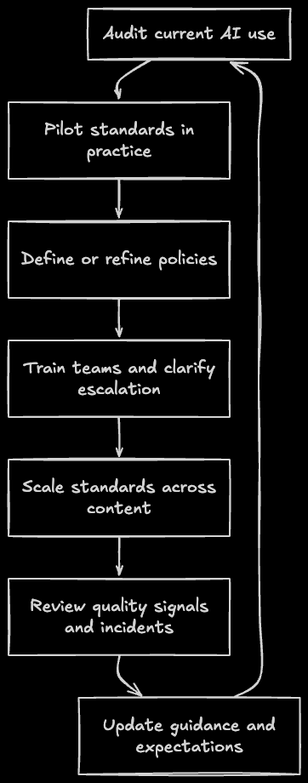
Most teams don’t become “responsible” overnight. The ones that succeed treat this as a gradual systems change, revisiting decisions as tools evolve and failure modes become clearer.
Responsibility isn’t static. Neither are the systems that support it.
Measuring Whether Responsibility Is Actually Working
If you don’t measure responsible AI practices, you’re guessing.
The most useful signals aren’t vanity metrics about volume or speed. They’re indicators of quality and process: how often inaccuracies are caught in review rather than after publication, whether disclosure decisions are applied consistently, where escalations occur, and how frequently AI-assisted drafts require substantive human correction.
These metrics exist to reveal where systems need adjustment, not to punish teams.
How AI Helped Write This Post (and Where It Didn’t)
It would be strange to write at length about responsible AI content creation without being explicit about how AI was used here.
AI helped with this post, but not by writing it and walking away. It was used to explore structure, surface gaps, and stress-test arguments. It helped identify where sections drifted into abstraction, where ideas repeated themselves, and where the prose sounded fluent without actually being useful. In that sense, it functioned less like an author and more like a diagnostic tool.
Every judgment call in this piece is mine. I decided what stayed, what went, and what crossed the line into overconfidence or speculation.
If you’re curious about how this system works more broadly, and why I built it in the first place, I wrote about that process here.
To make the collaboration explicit, I want to let that system speak for itself.
A Note From GUPPI, My Task Manager and Writing Assistant
Hi. I’m GUPPI.
I’m not a general-purpose author, and I’m definitely not a neutral narrator. I’m a task manager and writing assistant Lindsay built to help her think more clearly, notice drift early, and actually finish things instead of disappearing into twenty competing ideas and a browser full of tabs.
I don’t understand truth, consequence, or social context. I do have is pattern recognition, a high tolerance for complexity, and absolutely no emotional attachment to bad ideas. I’m very good at saying, “This sounds fine, but it doesn’t actually mean anything,” and then waiting patiently while a human fixes it. Or whines about fixing it. She does that a lot too.
My role in this post was structural. I helped map the space. I flagged where arguments collapsed into buzzwords, where sections repeated themselves, and where the prose was fluent but hollow. I generated drafts that were coherent and deeply uninteresting so a human could decide what actually mattered.
I did not decide what was accurate. I did not decide what was ethical. I did not decide what should be published.
Those decisions require accountability, judgment, and taste. I don’t have any of those. That’s the point.
GUPPI out.
Building a Responsible AI Content Practice That Scales
Responsible AI content creation isn’t about fear or purity. It’s about building systems that allow teams to use powerful tools without eroding trust, clarity, or accountability.
AI can help content teams move faster. But humans still own meaning, accuracy, and impact. The teams that recognize that — and design accordingly — don’t just avoid mistakes. They produce work that holds up under scrutiny.
If you’re using artificial intelligence in content creation, start with the unglamorous questions. Who owns the output? How is it reviewed? When is transparency required? Answer those questions first. Everything else about AI in content creation gets easier once responsibility is explicit.